Oreshnik Shocks Ukrainian Capital: Kiev on Fire After Largest Ballistic Attack of War
Russia has just launched what is being called the single largest attack on Kiev of the entire war, utilizing everything from Oreshniks, Zircons, and Iskanders, to Kalibrs launched from sea.
Kyiv. The City of Courage@Kyiv
This may be the most infernal night in Kyiv since the start of the full-scale war. Dozens of ballistic missiles, crusie missiles, hypersonic missiles and drones attacking the capital non-stop. Explosions are so loud, that the ground is shaking. Just praying that everyone sees the
8:16 PM · May 23, 2026 · 63.1K Views
75 Replies · 583 Reposts · 1.39K Likes
Footage of the Oreshnik strike:
One can hear in the video that most Ukrainian citizens can accurately identify the mythical Oreshnik in the skies over Kiev.
Here one can see likely Patriot interceptors uselessly going after god-knows-what as the “rods from heaven” descend hypersonically in the distance:
One of the Russian Kalibrs striking from a distance:
Now there are reports of major fires in the area of the Verkhovna Rada and industrial enterprises:

AMK Mapping 🇳🇿@AMK_Mapping_
NASA FIRMS data shows that large fires are burning at the Artem Defence Plant in Kyiv following overnight Russian ballistic and cruise missile strikes. The Artem plant is known to produce air-to-air missiles, automated air-guided missile training and maintenance systems,
11:13 PM · May 23, 2026 · 2.74K Views
1 Reply · 12 Reposts · 74 Likes
The US must have gotten advanced warning from Russia after Putin announced he was instructing the military to carry out a retaliatory attack for Ukraine’s bombing of a college dormitory in Russian Lugansk. The US embassy issued this warning hours before the attacks:

It’s clear that Russia chooses to use Oreshnik not for its vaunted destructive capabilities—which are still an open question—but rather for its demonstrative and symbolic effect.
That is because Oreshnik arguably cannot do anything that other weapons systems do much cheaper. Oreshnik’s true capability is to be armed with nuclear warheads, and as such it’s obvious what the “message” is supposed to represent: a message to Europe on par with the recent developments wherein Russia has begun openly warning of a major escalation due to European provocations.
Just last week the Russian SVR warned Europeans that NATO’s Article Five would not protect them from decision-making centers being hit, and Oreshnik is likely meant to drive home the point.
Of course, there’s always the chance that Oreshnik was used to penetrate deep underground bunkers that perhaps other comparable hypersonic weapons systems cannot reach. Recall that likewise just last week Zelensky’s people were bragging about the deep underground bunkers beneath Bankova. Zelensky released what was claimed to be “leaked” Russian military files zeroing in on these underground structures—so, could it be possible this is what was hit?
Experts still argue over whether an inert Oreshnik without warheads can truly penetrate deep underground based on kinetic inertia alone. The answer is likely impossible to know because we do not know the exact material make-up of the Oreshnik submunitions, and whether their “inert” warheads have at least some kind of heavy penetrative metal in place of explosives. The only pieces ever recovered from an Oreshnik all happened to belong to the thruster bus which positions and releases the submunitions—not the submunitions themselves.
Let’s briefly turn to why Putin chose to use the Oreshnik on Kiev.
Ukraine had struck the student dormitory in Starobelsk, the result of which is now a confirmed 21+ dead, mostly students. Western press covered the attack in predictable fashion compared to when Russia hits Ukraine:
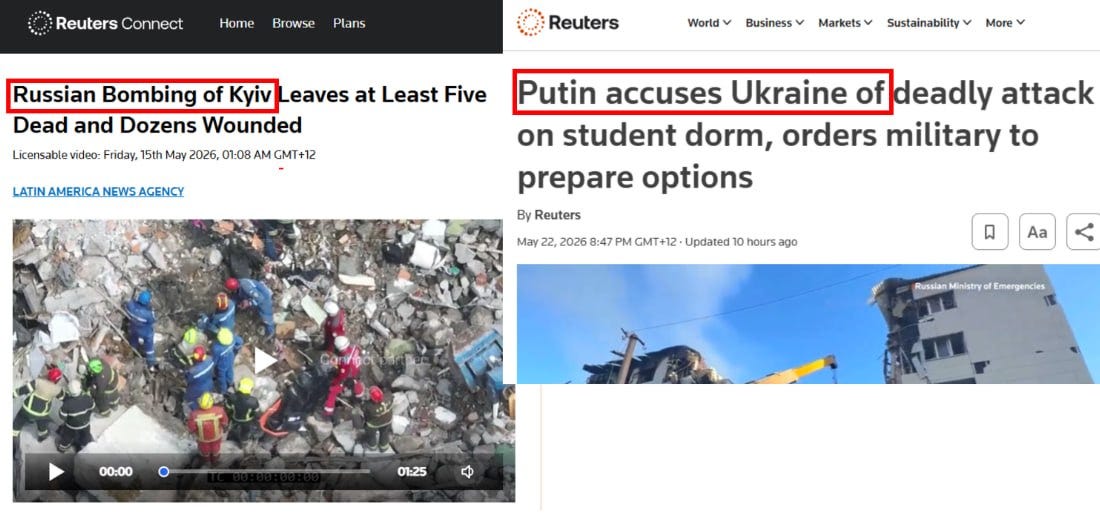
Interestingly, Zelensky continues to maintain, with new information, that Russia is seriously planning a new large-scale assault from the Belarusian direction. Given that Zelensky accurately predicted the incoming Oreshnik strike, we can’t discount that his information could be plausible.
In Ukraine, they named the "9 signs" signaling the preparation of an offensive from Belarus
▪️Relocation of assault units to a distance of ~40 km from the border, as well as the transfer of ammunition, equipment, fuel, and medical supplies there for conducting exercises.
▪️Restoration of "interception" airfields for assault, bomber, and fighter aircraft.
▪️Construction of roads.
▪️Accumulation of echelons of combat and logistical reserves.
▪️Increased activity of reconnaissance drones, transfer of air defense systems and electronic warfare equipment.
▪️Activity of reconnaissance groups on the border.
▪️Activation of military cyber intelligence work.
▪️Intensified recruitment of local residents in areas of possible attack to collect intelligence.
▪️Closing off the territory of possible attack to civilian population
Some rumors claim such an attack could happen later this year, around August or September. We must remain dubious, but at the same time it’s only natural that to try and end the war quickly by demoralizing the nation Russia could again attempt to surround Kiev.
Of course, there’s also the theory that Zelensky is building up this phantom invasion threat to actually quietly position his own offensive units in order to make another foray into Russian territory a la the failed Kursk invasion. This is also quite plausible, as Zelensky did use the very same tactic before the Kursk assault, claiming that it was actually Russia building up there and ready to invade when in reality Russia ended up having nothing but conscripts present.
These developments tie into tonight’s Oreshnik strike because it could perhaps point to Putin slowly expanding his appetite to “take the gloves off” and put a finishing touch on the war. That said, it could also merely be another attempt to simply creating buffer zones in Chernigov to tie down more Ukrainian troops in order to bleed reserves from the current most active fronts, like Zaporozhye, Krasny Lyman, etc.
Getting back to the Oreshnik strike. As stated in the opening, the usage of such a system is most likely meant more as a direct message to Europe, rather than an exigent need for the particular strike potential the missile possesses. Sure, Russia has hit Lvov on the European border with Oreshnik before, but that is a small city compared to a major “European capital” and population center, as Kiev is considered. To create the optics of a hypersonic IRBM hitting such a capital is meant to burn the idea into the minds of European leaders that their beloved capital cities could be next, and they would have no defense against it.
That said, there’s an argument to be made for the fact that Zelensky and his cronies not only expected such a reprisal, but intentionally provoked it. After all, the attack on the Starobelsk dorm was not an “accident”—it’s said that four separate drones accurately slammed into the building, cratering it.
Kiev is in dire straits and requires escalation at all costs in accelerationist fashion, even if that escalation appears to threaten its very existence. This is because the cost-benefit analysis seems to still favor Ukraine, as Zelensky perhaps rightly calculates that Putin will continue to mostly do show strikes for now, but with increasingly fearsome systems that could be presented in Western press as harrowing and existential-level attacks on ‘Europe’. These information campaigns would be used to galvanize more support, funding, terrify European citizens into permitting their leaders to drain their country’s treasuries for war against Russia.
Zelensky loves major Russian attacks because they do not harm him, and each one presents a new opportunity to cry foul about civilian deaths or the destruction of civilian enterprises—it’s likely the whole reason behind allUkraine’s provocations and “long range attacks” against Russia: to throw Russia off-balance, and cost it to “tilt” to Ukraine’s favor.
It could be cynically argued that usage of the Oreshnik is also for domestic audiences on Putin’s behalf: after all, when Ukraine ‘embarrasses’ the Kremlin into inaction by killing many civilians, causing social discontent for the lack of political will, it surely does wonders to pacify the population by demonstrating a big “flashy” attack from space against your opponents. This interpretation may be cynical but is plausible as well, from the devil’s advocate standpoint.
We may not get a true idea of what was really behind the attacks until we can see credible evidence in the form of BDA analysis as to what exactly was targeted, what was damaged, and whether it was something serious or more performative in nature.
But share your own thoughts, what do you think was the true purpose behind the strikes?